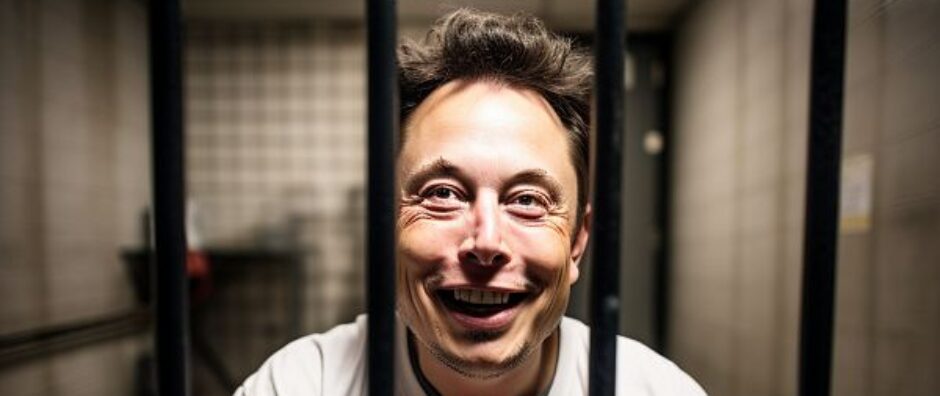
What if Wall Street valued your income the same way some analysts value SpaceX? Enter your salary and find out.
At ElonMuskArrested.com, we spend a lot of time looking at valuation claims, investor presentations, and promises about the future. Sometimes the easiest way to understand a number is to shrink it down to something personal.
That’s the idea behind the SpaceX IPO Calculator.
Instead of asking whether a $1.75 trillion valuation makes sense, let’s ask a simpler question:
What would happen if Wall Street valued you the same way?
If you earn $75,000 per year, the calculator applies the same revenue multiple implied by a hypothetical $1.75 trillion SpaceX valuation. Suddenly you’re worth millions of dollars.
Not because you made more money.
Not because your productivity increased orders of magnitude!
Not because you blew up some rockets.
Simply because somebody applied a very large multiple to your revenue.
The Math Behind the Joke
The calculator uses several figures frequently discussed in connection with SpaceX:
Estimated annual revenue
A hypothetical $1.75 trillion valuation
An $80 billion capital raise
Public funding and government contracts
Company debt
Using those figures, the calculator estimates:
Your new SpaceX-style valuation
Your fresh investor cash award
Your DOGE approved government mission bonus
Your approved debt limit
The goal here isn’t to predict the future.
The goal is to help people visualize how large valuation multiples work.
Why Revenue Multiples Matter
Traditional businesses are often valued using profits, cash flow, assets, or earnings.
Growth companies are often valued using future expectations.
Sometimes those expectations turn out to be correct.
Sometimes their light of consciousness dies out.
The higher the multiple, the more future success is already built into today’s price.
That’s why valuation discussions can become controversial. When investors are paying dozens of times annual revenue, they’re making a bet that the future will be dramatically larger than the present.
That’s not automatically wrong.
But it does require assumptions.
Lots of assumptions. Lots of rockets that don’t explode.
Totally Serious IPO Math
If You Were the SpaceX IPO, What Would You Be Worth?
Enter your yearly income and this calculator will value you like a hyped rocket company:
massive valuation, fresh investor cash, government mission money, and a debt limit that says,
“profitability is for people who do math.”
Your New SpaceX-Style Valuation$0
Fresh Investor Cash Award$0
Government Mission Bonus$0
Approved Debt Limit$0
Calculator assumptions: $1.75 trillion SpaceX IPO valuation, $18.67 billion estimated annual revenue,
$80 billion capital raise, $38 billion public-funding reference point, and $29 billion debt reference point.
This is satire using proportional math, not financial advice. Obviously. Somehow that still has to be said.
Elon Musk is doing that thing again: announcing a civilization-scale “next chapter” on X like it’s an app update. Except it’s fueled by a need for more money and your belief instead of cellphone data. This time, it’s a “self-growing city” on the Moon — a pivot from the long-running “we’re going to Mars” storyline. The tweet reads like a breakthrough. The reality reads like another used car salesman bait and switching on you again.
Whoops!
Let’s start with the obvious: you don’t get to declare a moon base into existence. or blowing up Starships. You get there by doing the hard parts first — reliably — and SpaceX hasn’t done the moon-base prerequisites yet. Not close.
Musk says the Moon is “faster” because trips are short and launch cycles are frequent, while Mars windows happen about every 26 months. That part is broadly true as orbital mechanics, and it’s exactly why the pivot is so revealing: this was known last time he made his Mars claims.
But here’s the problem: “nearer” isn’t the same as “achievable,” and a moon base isn’t a slogan — it’s a stack of technologies SpaceX still has to prove.
“We’ve launched hundreds of Falcon 9s” is not an argument for a Moon base
Musk fans are going to repeat the same defense: Falcon 9 has flown a ton. SpaceX goes to orbit constantly. Therefore, Moon base soon.
That leap is nonsense.
Low Earth orbit is roughly a couple hundred miles up. The Moon is roughly a quarter-million miles away. That’s 1000 times further. Does your car typically carry 1000 times more gasoline than it needs? More importantly, the Moon requires a completely different mission profile: deep-space navigation, long-duration life support, radiation exposure management, reliable lunar landing and ascent systems, surface power, surface comms, surface thermal control, logistics planning, and high-reliability operations where “we’ll iterate” is not a safety plan.
A thousand layups isn’t a slam dunk. A mile every day for a year still isn’t the same as running the Boston Marathon. Repetition in the easy arena doesn’t automatically transfer to the hard arena.
Starship is still a test program — and the Moon plan depends on Starship working perfectly else humans die.
NASA picked Starship as the Human Landing System for Artemis, originally via a 2021 award (widely reported at $2.89B) that later grew as the program evolved; Reuters reported the contract was worth about $4.4B as of late 2025.
That’s important because the “Moon base” claim is built on the assumption that Starship becomes a routine, high-cadence, high-reliability transportation system.
But look at where Starship actually is:
SpaceX has made progress with test flights(less likely to explode), including a major 2025 test flight that deployed dummy/simulator payloads and still ended as a controlled ocean landing outcome rather than an operational “deliver real cargo to orbit and reuse it like an airliner” milestone.
No human-rated life support. Starship has never carried a person, and SpaceX hasn’t demonstrated a full closed-loop life support system (air revitalization, CO₂ removal, humidity control, redundancy, fire safety) on Starship the way a real crew vehicle must.
No lunar surface systems exist. A “self-growing city” implies power, construction robotics, excavation, dust mitigation, thermal control, spares, comms, and maintenance. SpaceX hasn’t demonstrated any of that hardware working off-world.
Even the optimistic versions of the plan don’t skip the hardest part: on-orbit refueling, cryogenic propellant management, depot operations, and repeated launch cadence.
And that refueling requirement is the quiet killer.
The part Musk’s tweet doesn’t emphasize: a single Moon landing can require many Starship launches
Starship’s lunar architecture depends on launching a depot and then sending tanker flights to fill it. Estimates vary — even within SpaceX/NASA discussions — but the range is not “one rocket goes to the Moon.” It’s multiple launches per landing attempt.
Publicly discussed estimates have ranged from roughly 10–20 tanker flights (depending on assumptions) and other commentary has put the total launch count per landing in the “high teens.”
That means this isn’t “one mission.” It’s a campaign of launches that all have to go right, close The math problem SpaceX can’t tweet away
A lunar Starship mission isn’t “one rocket goes to the Moon.” It’s a campaign: multiple Starship launches, multiple tanker flights, multiple dockings, multiple propellant transfers, and then a lunar departure and landing. And here’s the part Musk never emphasizes: risk compounds.
If each launch (or major event) has a success probability of p, then the chance that all required launches/events succeed is roughly:
P(all succeed) = pⁿ
Where n is the number of launches/events you must nail in a row.
So if Starship is only 50% reliable in practice right now (and early test programs often look like that), then:
5 launches in a row: (0.5)⁵ = 3.125%
10 launches in a row: (0.5)¹⁰ = 0.0977% (about 1 in 1,024)
20 launches in a row: (0.5)²⁰ = 0.000095% (about 1 in 1,048,576)
That’s not “pessimism.” That’s just what happens when you need many consecutive successes.
And even if you assume Starship becomes 90% reliable per launch, that still compounds fast:
10 launches: 0.9¹⁰ = 34.9%
20 launches: 0.9²⁰ = 12.2%
To make multi-launch lunar architecture realistic, you don’t need “pretty good.” You need near-airliner reliability, because any single failure can wipe out the whole campaign — or worse, strand hardware and blow the schedule and budget into the sun.
That’s why “we can launch every 10 days” is marketing. The hard question is whether they can launch reliably, repeatedly, and perform in-space refueling with almost no failures — because the math punishes you for every weak link.
All of this…just to get a single ship to the moon once.
Meanwhile, NASA and Blue Origin are actually doing “Moon” as a program — not a tweet
The funniest part of Musk’s Moon pivot is that NASA’s Artemis program already exists as the actual moon-return framework, and NASA has also selected Blue Origin as a second lunar lander provider for Artemis V.
So yes: the Moon is being worked on — but the credible work looks like contracts, milestones, testing programs, and redundancy. It does not look like “self-growing city” language on social media.
And if you want the “who’s closer” conversation to be adult and evidence-based, the question becomes:
Who has demonstrated the needed building blocks?
Who is meeting milestones?
Who is building the supporting systems (power, logistics, comms, surface operations) instead of just selling a cinematic ending?
This pivot reads like PR timing — especially with SpaceX’s money-and-structure chaos in the background
This is where the “moon base” claim starts to feel less like a technical roadmap and more like a grift shift. Last week he was tweeting that they were going to build 1 million ai data center satellites. The commonality in both grifts is that they require near infinite amounts of money.
Reuters reported Musk recently said SpaceX acquired xAI — Both Spacex and Tesla have recently “invested” 2 billion dollars into xAi. It’s clear that xAi burns billions of dollars per month.
It was only months ago that X(Twitter) was acquired by xAi. Twitter was initially acquired by Musk, Diddy, and some Saudis along with $13 billion in debt and interest payments that Twitter didn’t make enough money to cover. This is the reason for Musk immediately trying to charge everyone on his free speech social media website. This is also the ultimate reason for merging with xAi and then SpaceX…a need for more money.
And that’s the pattern: when a promise nears the moment it must become real, it gets replaced by a new promise that’s just far enough away to be uncheckable — but close and expensive enough to keep believers emotionally invested and the lights on a the grift factory.
Mars was the religion. Now the Moon is the religion. Same structure. New wallpaper. Increase in monthly membership.
The bottom line
A Moon base isn’t impossible in the abstract.
But Elon Musk tweeting about a “self-growing city” is not evidence that SpaceX is about to build one, and it’s definitely not evidence that Starship is ready to carry the entire Moon architecture on its back. It’s proof Musk needs more money. It’s a teaser for the SpaceX IPO.
Right now, what we have is:
A pivot announced on social media.
A Moon “plan” that still depends on multi-launch refueling campaigns.
A test program that has shown progress(less explosions), but not operational maturity.
And a track record of “timelines” that slide when they meet reality or the bills come due for Musk’s other grifts.
So no: Musk isn’t “building a Moon base.” He’s begging for more money. Again.
He’s building a new story — because the old story got reality checked by his parallel grifts and desire to remain relevant via his bank accounts.
Documents vs. denials: Elon Musk and the Epstein files.
The latest Epstein-file release isn’t “internet gossip.” It’s a major tranche of U.S. Justice Department material that
has reignited global scrutiny—not just because of the scale, but because the documents include communications and
contact trails involving influential people across business and politics.
Multiple outlets report the DOJ release includes millions of documents, plus large volumes of images and video.
[Source: AP]
1) What the newly released records reportedly show about Musk
Reporting on the newest DOJ release describes email exchanges between Elon Musk and Jeffrey Epstein, with messages
about timing and plans to meet up, including discussion that references Epstein’s island and the broader Caribbean
social circuit.
[Source: The Guardian][Source: Fortune]
CBS News also reported on the latest drop as including “apparent emails” between Epstein and Musk and covered Musk’s
reaction to the release.
[Source: CBS News]
Important: being mentioned in released files or appearing in correspondence does not automatically mean someone committed a crime.
The DOJ has indicated the newly released materials do not establish grounds for new criminal charges on their own,
and officials have cautioned that some claims in the material may be unverified.
[Source: AP]
2) Why the contradiction matters: denials vs. documents
The public reaction is not about a name appearing in a file. It’s about contradiction—about whether the public-facing
storyline (“nothing to do with it”) matches what documents and contemporaneous communications show or imply.
When files contain direct correspondence, “I never had ties” becomes much harder to sell as a clean, one-sentence explanation.
[Source: The Guardian]
3) The pattern: weaponize accusations, then call everyone else a fraud
You don’t need to diagnose anyone to recognize a public pattern: accuse first, escalate fast, and use the most radioactive labels
available—then retreat into semantics after the damage is done.
Example A: “Pedo guy” (Thai cave rescue)
In 2018, Musk called British cave diver Vernon Unsworth “pedo guy” during the Thai cave-rescue dispute.
Unsworth sued for defamation; a jury later found Musk not liable.
[Source: Reuters][Source: The Guardian]
The takeaway is not the verdict. It’s the behavior: Musk publicly deployed one of the most explosive accusations imaginable
against another person in a global news cycle—and only later tried to frame it as slang/insult rather than assertion.
[Source: WIRED]
He then later did the same thing to ex-babysitter of his kid Donald Trump…when Trump refused to extend the billions of dollars of tax payer funded EV Credits Musk’s businesses entirely rely upon. Calling Trump a “PEDO” on Twitter…the platform he purchased with Diddy to help Donald obtain his presidency while being a felon.
Example B: the SEC “funding secured” episode (Aug 7, 2018)
On August 7, 2018, Musk tweeted he was considering taking Tesla private and that “funding secured.”
The SEC charged Musk with securities fraud for false and misleading statements, and Musk later settled; Tesla also settled
related charges tied to disclosure controls around Musk’s communications.
[Source: SEC (charge)][Source: SEC (settlement)]
Example C: California DMV finding Tesla’s marketing misleading
In December 2025, California’s DMV announced its decision adopting an ALJ’s findings that Tesla violated state law
through false advertising related to “Autopilot” and “Full Self-Driving Capability,” noting Tesla had already shifted
terminology to “Full Self-Driving (Supervised)” and describing penalties/required changes.
[Source: California DMV]
Put simply: when Musk positions himself as the world’s hall monitor for “fraud,” there is an unusually long paper trail of regulators
and agencies saying, “No—your claims were misleading.”
[Source: SEC][Source: California DMV]
4) The Epstein release is bigger than Musk—and the fallout is real
One reason this release has exploded is that it’s forcing institutions to respond in real time. The AP reports resignations
and political fallout tied to the newly released materials.
[Source: AP]
There are also serious concerns about how the release was handled. A Wall Street Journal review found the DOJ release
failed to properly redact at least dozens of victim names, including minors, prompting criticism and calls for corrective action.
[Source: WSJ]
5) Bottom line
Responsible reporting separates “named in files” from “proven crime.” But it also separates “clean PR narrative” from
“documents that complicate the story.”
If the public reads a timeline where Musk:
publicly used sexual-predator insinuations as a weapon in a high-profile feud [Reuters]
was charged by the SEC over misleading market-moving claims [SEC]
and had Tesla’s driver-assist marketing called misleading by California’s DMV [CA DMV]
while fresh reporting ties him to direct email correspondence with Epstein [The Guardian]
…then the “he’s just misunderstood” storyline stops sounding like analysis and starts sounding like denial.
Tesla’s shareholders just “voted” to approve what’s being called a trillion-dollar pay package for Elon Musk — and the financial media can’t stop drooling over it. CNBC, Bloomberg, The Verge — everyone’s repeating the number like it’s a math problem they never learned how to solve.
So let’s do the math they won’t.
A Pay Package With No Pay
The claim goes like this: Musk “doesn’t take a salary,” therefore he deserves to make a trillion dollars someday, if Tesla meets certain performance milestones. Those milestones? Not profits. Not innovation. Not even vehicle quality.
They’re just stock price targets. That’s right — the “performance” metric is how much you, the investor, can be tricked into paying for a share of Tesla stock. It’s the corporate equivalent of a pyramid scheme: the stock goes up because you believe it will go up, and Musk gets richer because you believed it.
Musk isn’t being rewarded for building cars, batteries, or robots. He’s being rewarded for keeping the bubble inflated.
The Math Nobody Does
Over its entire two-decade history, Tesla has made roughly $40 billion in total net income, and half of that came from government subsidies and regulatory credits — taxpayer money. That’s not free-market success or capitalism; that’s welfare for billionaires.
Meanwhile, Musk has already sold over $40 billion worth of Tesla stock. So he’s personally extracted more money than the company has ever earned. Every dollar Tesla ever “made” has already left the building — and it’s sitting in his pocket.
And this is the guy shareholders just voted to make the world’s first trillionaire.
The Trillion-Dollar Illusion
Let’s be clear: Musk will never see a trillion dollars in cash. He’s not even a real billionaire in the traditional sense. His wealth is almost entirely stock — stock he’s borrowed against. When you hear “Musk’s net worth dropped $20 billion this week,” that’s not theoretical. It means his loan collateral just lost value. If Tesla’s price ever falls far enough, the banks will come for him first.
He’s a margin call away from bankruptcy, not a trillionaire. And the board knows it.
The Boardroom Bubble
Tesla’s board — stacked with his friends, family, and loyalists — has already approved one record-breaking compensation package before: the $55 billion deal from 2018. That one was twenty times smaller than this new one and still got struck down in court for being unreasonable. Now they’re back at it — this time with a plan that’s legally, mathematically, and morally indefensible.
Board Chair Robyn Denholm has cashed out millions in shares. Kimbal Musk, Elon’s brother, has dumped tens of millions more. If they really believed in the company’s “future success,” why are they selling? Because they know the only real product left is hype — and the only person buying it is you.
Musk Awards himself more of your money.
The Cult of the Trillionaire
Let’s call it what it is: a mass financial cult.
Shareholders have become unpaid volunteers in Musk’s GoFundMe empire — emotionally and financially invested in a man who hasn’t actually done the work they’re rewarding him for. Musk hasn’t spent years in Tesla factories engineering vehicles; he’s been on Twitter, in courtrooms, and at government events, burning time and taxpayer cash while pretending to be Tony Stark.
He didn’t found Tesla. He bought his way in. He didn’t invent the electric car. He rebranded it. He didn’t design the Cybertruck. He overruled the designers and gave us a stainless-steel meme with shattered windows and a recall list longer than the owner’s manual.
And yet, his fanbase calls this “innovation.”
A Robot Army and a Delusion
Musk claims he needs more control over Tesla before he can “safely” build his robot army — as if that sentence doesn’t immediately disqualify him from having one. If the moral question of “who controls the robots” even has a debate, and one of the options is Elon Musk, then the answer is simple: don’t build them.
The idea that Musk’s self-declared genius justifies global control is the same fantasy that drives this trillion-dollar myth. It’s not capitalism. It’s hero worship dressed up as economics.
Reality Check
Let’s recap:
Tesla lifetime profits: ≈ $40 billion
Musk stock sales: > $40 billion
Proposed “pay package”: up to $1,000 billion
Actual corporate logic: nonexistent
You can’t justify paying someone twenty times what the entire company has ever earned — especially when the company wouldn’t exist without subsidies, recalls, and hype. That’s not capitalism. It’s delusion economics — a trillion-dollar participation trophy for the world’s most overpaid mascot.
Final Thought
Every time the media says “Musk could make a trillion dollars,” they’re proving how little anyone understands about value. A company’s worth is supposed to be what it earns — not what it pretends it might someday. And a CEO’s worth isn’t measured by his Twitter followers or meme coins — it’s measured by the truth in his numbers.
By that measure, Musk’s true pay package is zero. Because that’s what this whole thing is worth.
A wannabe Tesla influencer @techidani recently posted a photo of her car driving itself while she sat hands-free, A Tesla influencer recently posted a photo of her car driving itself while she sat hands-free, proudly captioned:
“Nice to know my baby is being driven around in the world’s safest car 👶.”
The image shows her legs stretched out, one hand on her lap, and the other clearly raised in front of her face to take the photo — meaning no hands on the wheel, no eyes on the road, and an unborn baby inside her.
What she doesn’t mention is that she’s financially incentivized to promote Tesla. Her Beacons profile includes a Tesla referral link — a commission-based program that rewards users for new buyers. In other words, this isn’t just bad judgment — it’s advertising. And when that advertising involves provably false safety claims, it starts looking a lot like fraud.
As we previously covered in “Tesla’s Unpaid Cult”, thousands of Tesla fans have become unpaid — or barely paid — salespeople for Elon Musk, pushing false narratives in exchange for points, perks, or free Supercharging miles.
Hands Off the Wheel, Eyes on the Commission
Her social bio looks less like a personal profile and more like a mini Tesla storefront — complete with links for Cybertruck accessories, Amazon gadgets, and that referral link promising savings on your next Tesla.
She’s risking her baby’s life for a billionaire’s referral program. It’s hard to think of a clearer example of what happens when marketing replaces morality.
Tesla’s “referral influencers” are unpaid advertisers — an army of believers doing Musk’s PR for free. They’ll risk their safety, and their credibility, to convince strangers that buying an electric car somehow makes them pioneers.
The Data: Tesla’s “Safest Car” Claim Is a Lie
The National Highway Traffic Safety Administration (NHTSA) has repeatedly investigated Tesla for fatal crashes linked to Autopilot and FSD.
While human drivers average about 500,000 miles between accidents, Tesla’s Full Self-Driving still struggles to go 100 miles without human intervention — according to independent testers and even loyal fans attempting long-distance drives.
One recent FSD road trip ended in a crash before even reaching 100 miles. Yet somehow, the narrative continues: “world’s safest car.”
Safety Theater Disguised as Technology
The photo itself is textbook Tesla propaganda — calm, confident, and completely unearned.
A steering wheel untouched. A digital map glowing with fake precision. A car moving itself through city streets while a pregnant woman rests one hand on her thigh and uses the other to hold her phone vertically in front of her face to take the picture.
That means zero hands on the wheel, zero eyes on the road, and one child seat in the back — all to help Elon Musk sell more cars.
This isn’t a portrait of progress. It’s a perfect snapshot of the illusion Tesla built: people mistaking risk for innovation, and marketing for safety.
Tesla hasn’t just redefined driving — it’s redefined recklessness as content.
The Cult of Musk
This isn’t an isolated case — it’s the culture Musk built.
From “FSD Beta” enthusiasts livestreaming near-misses to influencers turning their families into props, Tesla’s success depends on the unpaid faith of its followers.
These people aren’t just fans — they’re part of a financially incentivized pyramid, selling safety myths for clicks while putting themselves and others in danger.
And when those false claims lead to harm, it’s not just unethical — it’s actionable. False advertising for financial gain meets the legal definition of fraud.
Final Thought
Every time someone calls a Tesla the “safest car,” a statistic somewhere disagrees. Every time someone posts their hands-free moment, it’s another reminder of how deep the delusion runs.
This woman doesn’t represent empowerment or tech literacy. She represents a marketing system so manipulative it can turn a mother-to-be into a brand ambassador for her own risk.
It’s not “the world’s safest car.” It’s the world’s most dangerous ad campaign.
Tesla didn’t just change how cars are sold — it changed who sells them. Instead of paying real salespeople a living wage, Elon Musk turned every Tesla customer into a potential unpaid minion speaking on his behalf. Every new owner gets a referral link, an invitation to join what amounts to a volunteer marketing cult.
You ever wonder why so many people leap to Musk’s defense online? It’s because they foolishly think they can somehow get rich by working for free for the richest man in the world.
No Dealerships, No Oversight
Every other automaker in the United States uses licensed dealerships. Those sales reps are trained, regulated, and legally accountable for what they say. They can’t lie about features or safety without risking fines or losing their license.
Tesla avoided that entire system. By going “direct to consumer,” the company erased a layer of legal oversight — no third-party dealers, no accountability. Then, instead of hiring trained salespeople, Tesla quietly replaced them with its own customers. Every buyer gets a referral link and the subtle message: spread the word and earn rewards.
The result? A decentralized sales army of ordinary people repeating claims Tesla itself can’t legally make.
Behavioral Fraud — The MrBeast Model
Tesla’s referral system runs on the same psychology as YouTube giveaways. It’s the “get lucky” effect: the sense that if you just promote hard enough, Musk might notice you. Maybe you’ll get free Supercharging. Maybe a Tesla credit. Maybe Elon himself will “like” your tweet.
It’s the MrBeast model for sociopaths — you’re not selling cars, you’re selling the dream of being “chosen.”
This isn’t fandom; it’s behavioral fraud. When a Tesla owner with a referral link posts that Full Self-Driving is “basically ready,” or that the car “drives itself better than humans,” that’s a commercial claim tied to financial incentive. They’re not just fans anymore. They’re unlicensed sales reps.
And that distinction matters. If those claims are false — and people buy based on them — it becomes false advertising. In legal terms, it’s fraud. Whether or not they realize it, many of these Tesla promoters are already exposing themselves to potential liability.
A Pyramid of Belief
Musk has effectively built a pyramid scheme — but the currency isn’t money, it’s attention and belonging. Each new owner becomes a salesman for the next, spreading Tesla’s mythology instead of its specs. They defend Musk as if defending a religion, not a product.
That’s why you can’t reason with them. Their sense of identity is tied to their purchase. They’re emotionally invested in a machine that depreciates every day but somehow still feels like “the future.”
When SpaceX buys Cybertrucks or Musk posts AI-generated propaganda of Optimus robots on Mars, these owners feel validated — as if they’re part of a cosmic mission instead of a marketing funnel. It’s cult psychology 101: belief sustained through illusion of progress.
Taxpayer-Funded Evangelism
Tesla wouldn’t exist without billions in government subsidies, rebates, and tax credits. Yet those same taxpayers are the ones being manipulated by Tesla owners who shill the company online.
Every referral post is essentially a taxpayer-funded lie — a message crafted by someone who benefited from public money, now encouraging others to do the same. Musk doesn’t need PR staff. He has a digital congregation working for free, running on faith and fumes.
Legal Exposure — and a Coming Reckoning
Let’s be clear: when you post about Tesla with a referral link, you’re participating in commercial activity. If your claims are false, exaggerated, or misleading — especially about Full Self-Driving — you could be sued under U.S. consumer protection and advertising laws.
You don’t need to work for Tesla to be held liable; all it takes is demonstrating financial motive and public deception. And those conditions are met every single day on X (Twitter).
We’re documenting this pattern — the false claims, the referral links, the coordinated hype — because someday, when regulators or victims’ families start asking who was responsible, there will be a public record.
The Cult That Sells Itself
Musk has achieved what no marketer in history ever has:
A global salesforce that costs him nothing.
A brand defended online by zealots who think they’re investors.
A system where the victims advertise for the scam.
Every referral link, every glowing post, every defensive tweet — it’s all part of the same machine. Tesla doesn’t need truth in advertising because it no longer advertises the truth.
It advertises belief.
And belief, when weaponized, becomes something far more dangerous than a defective car — it becomes a culture of fraud.
Bottom line: If you’re shilling Tesla online, if you have a referral link, and you’re making claims about safety, autonomy, or “Full Self-Driving,” understand this — you’re not a fan, and you’re not part of the mission. You’re a marketing asset in a trillion-dollar deception. And when the lawsuits come, you won’t just be watching. You’ll be named in the filings.
In a stunning new opportunity for self-sacrifice, Elon Musk has reportedly opened a fan sign-up portal for what he’s calling “Starship Influencer Testing.” The concept is simple: instead of waiting decades for astronauts to volunteer, why not let Musk’s most devoted followers climb aboard early—literally—and help test the world’s most explosive stainless-steel monument to optimism.
Applicants are encouraged to “do it for humanity,” according to a tweet Musk posted between memes about Dogecoin and population collapse. “We’re entering the next phase of testing,” Musk explained. “We’ve completed 11 flights so far, and it’s clear we’ll need orders of magnitude more before reaching orbit reliably. The Moon is roughly 1,000 times farther than low Earth orbit, and Mars is—depending on orbital alignment—up to a million times farther. So yeah, we’ll need a few more.”
The new “fan testing” initiative will require participants to pay a $420.69 application fee, which Musk says “helps weed out the unserious.” Successful applicants will receive a digital certificate on X (formerly Twitter), an NFT commemorating their willingness to risk vaporization, and possibly a retweet from Musk himself—assuming their launch livestream goes viral before impact.
While critics have compared the program to the Soviet Union’s use of dogs in early spaceflight, Musk was quick to dismiss the analogy. “This is different,” he said. “These people can tweet.”
SpaceX engineers, speaking anonymously, admitted that the company’s first 11 test flights have produced “mixed” results, though Musk insists that explosions are “rapid unscheduled disassemblies” that provide “valuable data.” He reassured investors that “each fan test will bring us closer to Mars, emotionally if not physically.”
When asked if the program could result in loss of life, Musk replied, “Sure, but the sun’s going to destroy all life on Earth eventually if we don’t relocate. So really, not doing this would kill more people.”
He added that the test program “is basically like Noah’s Ark, but faster and with better merch.”
Editorial Note: The launch window for “Starship Fan Test 12” is reportedly set for next quarter, pending FAA approval and enough volunteers with strong Wi-Fi signals.
In October 2016, Elon Musk promised that a Tesla would complete a fully autonomous drive from Los Angeles to New York by the end of 2017. That never happened. Instead, nearly a decade later, Tesla’s “Full Self-Driving” (FSD) is still lurching through beta tests, and a much-hyped coast-to-coast attempt just ended in a wreck after a mere 58 miles.
The Test That Never Got Off the Ground
Tesla superfans “Bearded Tesla” and “Josh West” — grown men who’ve essentially made Elon Musk their last name — set out this month from San Diego, hoping to cross 2,362 miles to Jacksonville, Florida using Tesla’s FSD v13.2.9 without human intervention. Within the first hour, their big coast-to-coast stunt was over.
The car failed to recognize a large piece of debris — described as a “huge girder” — lying on the interstate. Despite being visible from over 700 feet away, Tesla’s visualization software never registered it. At 77 mph, the Model Y plowed straight into the object, launching the brand-new car into the air before slamming back down.
The driver only got a warning to “take over immediately” after the crash had already happened.
In October 2016, @ElonMusk claimed that Tesla would complete a fully autonomous drive from LA to NYC by the end of 2017. @BeardedTesla and @JoshWest247 set out on a journey from San Diego, CA to Jacksonville, FL to see whether it was possible for FSD v13.2.9 to drive 2,362… pic.twitter.com/7hJahaSLXn
Tesla FSD coast-to-coast attempt crash — Model Y fails to detect road debris and wrecks after 58 milesTesla FSD coast-to-coast attempt crash — Model Y fails to detect road debris and wrecks after 58 milesTesla FSD coast-to-coast attempt crash — Model Y fails to detect road debris and wrecks after 58 miles
Ten Years of Promises
This isn’t just one bad test. It’s the continuation of a decade-long pattern of false promises:
2016: Musk promised a coast-to-coast drive by 2017.
2016 onward: Tesla began marketing FSD as “10 times safer than a human driver.”
Repeatedly: Musk has claimed FSD would be unsupervised “by the end of the year.”
2025: Tesla enthusiasts can’t even leave San Diego County before crashing.
Supporters often excuse these failures by saying autonomy is “just around the corner.” But “just around the corner” has lasted nearly ten years.
The Fraud of “10 Times Safer”
Fans like Lex Fridman — who built an entire brand around promoting Tesla and AI safety — have echoed Musk’s line that FSD is safer than human drivers. That claim collapses instantly when you look at the data.
Tesla drivers have some of the highest accident and fatality rates of any major car brand. The crash intervention times are poor, with the system often failing to alert until it’s already too late. The marketing spin doesn’t change the math: FSD isn’t safer. It’s reckless.
Why This Matters
This is not a harmless tech demo gone wrong. People have died in Teslas with Autopilot or FSD engaged. Cars have plowed into stationary objects, emergency vehicles, and pedestrians. Passengers have burned alive, trapped inside vehicles they couldn’t escape.
When people believe Tesla’s hype, they put their lives — and everyone else’s lives on the road — at risk.
The BeardedTesla crew didn’t just damage a car. They demonstrated, yet again, that Tesla’s software cannot safely handle the real world. And yet Musk still insists unsupervised FSD is coming by the end of this year.
The Bigger Picture
Tesla markets FSD as a vision of the future, but the reality is clear:
The tech fails in obvious, life-threatening situations.
The company has missed its own deadlines for nearly a decade.
Fans and influencers act as unpaid hype men, excusing disaster after disaster.
Regulators continue to lag behind, even as crashes pile up.
This isn’t innovation. It’s a rolling public beta test using paying customers as crash dummies.
Conclusion
The coast-to-coast FSD attempt should have been a chance for Tesla to prove its boldest claims. Instead, it proved the opposite. After nearly ten years of promises, Tesla still can’t make it 60 miles without putting lives in danger.
At what point do we stop calling this “progress” and start calling it what it is — fraud?
Every time I scroll through Twitter or Facebook, I run into them: grown men with freshly minted accounts, often created just days ago, whose sole purpose in life is to defend Elon Musk. The names aren’t subtle, either. One recent gem was literally @IAmHereForElon. You can’t make this up.
It’s pathetic. It’s cringe. And it tells you everything you need to know about how far idol worship has gone in the age of tech billionaires.
## Wasting Free Will Think about this: you live in a world of unlimited opportunity. You could hike a state park, start a business, build something meaningful, even just read a book and actually improve your life. Instead, there are men out there burning their free will on creating fake accounts to argue with strangers about Elon Musk’s honor.
They’re not coding. They’re not innovating. They’re not starting companies. They’re not getting fit. They’re not even living their own lives. They’re just logging on and screaming “you’re jealous!” or “cope harder!” to anyone who points out that Musk’s empire is riddled with lies, recalls, and financial engineering.
## Imaginary Rewards, Real Wasted Time What’s the endgame for these people? Do they think Elon is going to personally thank them for defending him online? That Tesla stock will magically go up because of their comment section crusade? That the billionaire who doesn’t know their name will somehow reward their loyalty?
It’s the same parasocial delusion you see with cult leaders. Musk isn’t handing out free Teslas to his Twitter knights. He’s laughing all the way to the bank while they burn their time and energy arguing with critics.
## Why Are They Like This? It’s easy to laugh at the ridiculous usernames and the shaky grammar in their comments, but the deeper question is: *why do these people exist in the first place?*
Part of it may be insecurity. Some of these men aren’t just lacking direction; they’re actively afraid. Following another man, especially one who seems powerful, fills that void. It’s the oldest instinct in the world: when you don’t know what to do, you cling to the loudest leader.
There may even be a biological undertone. Some researchers tie low testosterone to submissive, fearful behavior. But popping testosterone gels isn’t going to cure the deeper issue. This isn’t just about hormones — it’s about character, courage, and self-respect. A man with a strong sense of self doesn’t wake up one day and decide to dedicate his free time to defending Elon Musk on Twitter.
Another factor is what you could call the “father gap.” Many of these men simply never had a dad who showed them how to build, how to work, how to treat people with respect. Instead of learning how things are actually made, they cling to Musk’s PR as if it’s gospel. They mistake marketing for engineering and insults for leadership — because no one ever showed them better. Musk himself is hardly a role model; he’s built his empire on deception, grifting, and childish name-calling. It’s no surprise his most loyal followers mirror the same behavior.
And finally, there’s the internet itself. It should have been the great equalizer — a tool for anyone to learn, grow, and improve their life. Instead, inequality has ballooned, and the internet has become a marketplace of worship. Instead of building their own future, these men choose to donate their time, money, and mental energy to billionaires who already have everything.
It’s a tragedy dressed up as fandom. Instead of men becoming stronger, smarter, and more independent, they’ve turned themselves into unpaid bodyguards of a man who doesn’t even know their name.
## Worship Never Gets You Anywhere If you want to improve your life, worship won’t get you there. Following won’t get you there. Fake accounts sure as hell won’t get you there. Doing something does.
When you make your whole identity “I am here for Elon,” you’re basically admitting: *I am not here for myself.* And that’s the saddest part of all.
Tesla just got slammed with a $329 million verdict for a fatal Autopilot crash—and in the very same breath, the board is handing Elon Musk a $23 billion pay package as a reward for… what, exactly?
Musk hasn’t even been at Tesla. He’s been busy playing dictator at Twitter/X, launching racist meme bots with Grok, and merging his failing companies into new ones to avoid scrutiny. Meanwhile, Tesla’s business is deteriorating by almost every metric:
Sales are down
Executives are leaving
Insiders are dumping stock
Full Self-Driving is a proven fraud
California is banning RoboTaxis
Tesla leads all automakers in crash deaths per vehicle sold
Let that sink in: The company with the most deaths per car sold, which just lost a precedent-setting lawsuit for Autopilot killing a third party, is now rewarding Musk with an unearned $23 billion bonus. For what? For making the stock go down?
This isn’t capitalism. It’s Ponzi-style stock market fraud, and Musk’s only talent is extracting wealth before the lies collapse.
He’s done it before. He’ll do it again.
Musk made his early money hyping Zip2, which he sold for far more than it was worth. He then tried to turn X.com into an all-in-one payments platform, but it failed—and he was ultimately fired from what became PayPal, which he didn’t name and didn’t build. Now he’s slapped the same failed name, X, on Twitter in yet another attempt to make his original failure look like a long game.
He funnels government money into Tesla, SpaceX, and SolarCity—using false promises to raise valuation, taking personal profits, and moving on before the house of cards can fall.
Now he’s doing it again.
Tesla’s valuation is nowhere near reality. If it were priced like Ford or Nissan based on profits (not subsidies), it might be worth $20–$40 billion total. That would make Elon Musk’s entire stake worth maybe $4 billion at best. Instead, the board just awarded him a $23 billion bonus on top of his original holdings—a payout disconnected from any kind of actual success.
It’s not just absurd. It’s another sickening display of misguided techno-fantasy fandom gone awry—fueled by people who wouldn’t know a scientific principle if it drove over them in a malfunctioning Tesla. And somehow, they’re still asking for it.
What if Wall Street valued your income the same way some investors value SpaceX? Enter your annual income and discover your new billionaire-approved valuation. Continue reading →
Elon Musk claims SpaceX has “shifted focus” to a self-growing city on the Moon “in under 10 years.” But Starship still isn’t an operational system, lunar missions require many launches and in-space refueling, and failure risk compounds fast. This isn’t a moon base plan—it’s a narrative pivot. Continue reading →
Newly released Justice Department records include email correspondence between Elon Musk and Jeffrey Epstein—messages that undercut Musk’s long-running public posture of “I refused” and “nothing to see here.” This is also the familiar Musk pattern: accuse others of what you’re doing, scream “fraud,” and keep the hype machine running while the legal and financial reality closes in. Continue reading →
Tesla’s trillion-dollar pay package isn’t real — it’s a headline built on hype. The company hasn’t earned even 1/20th of that, Musk already cashed out more than it ever made, and the shareholders voting for it are worshipping a ghost of value. Continue reading →
A pregnant Tesla influencer called her car “the world’s safest” while driving hands-free and filming herself — all to push her Tesla referral link. It’s not tech innovation, it’s advertising disguised as safety, and financially motivated false claims like this cross into fraud. Continue reading →
Tesla didn’t just change the auto industry — it turned customers into a free marketing army. This article exposes the referral system, the cult-like psychology, and the legal risks of spreading FSD lies. Continue reading →
Elon Musk unveils a new program called “Starship Influencer Testing,” where fans can pay $420.69 to join upcoming Starship launches. The initiative mixes danger, devotion, and delusion — a parody of space-age fandom and Musk’s cult of personality. Continue reading →
Elon Musk promised a coast-to-coast self-driving Tesla nearly a decade ago. In 2025, YouTuber Bearded Tesla’s Model Y didn’t even make it out of San Diego — crashing just 58 miles into the trip. Continue reading →
Grown men are creating fake social media accounts just to defend Elon Musk online — a sad mix of insecurity, idol worship, and wasted free will. Instead of building their own lives, they’ve turned themselves into unpaid bodyguards for a billionaire who doesn’t even know their names. Continue reading →
Tesla just got slammed with a $329 million verdict for a fatal Autopilot crash—and in the very same breath, the board is handing Elon Musk a $23 billion pay package as a reward for… what, exactly? Musk hasn’t even been at Tesla. He’s been busy playing dictator at Twitter/X, launching racist meme bots with Grok, … Continue reading →