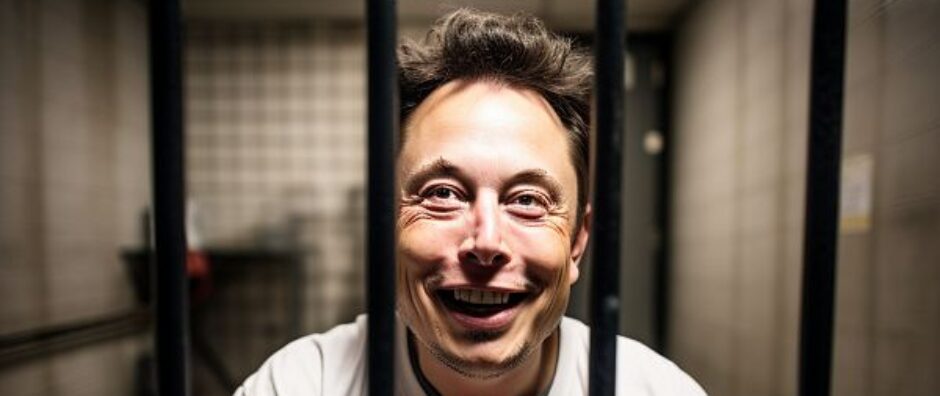
Elon Musk is straight-up robbing Tesla and SpaceX shareholders blind — and they’re just letting him.
This is just SolarCity 2.0. Actually, at this point, it’s 2, 3, and 4. Same scam, different bubble.
First, Musk told Tesla shareholders:
“If you don’t approve my $55 billion pay package, I’ll take AI with me.”
They approved it — and then he still took the AI anyway. He formed xAI, made Grok, started diverting Tesla’s AI talent to it — and now he’s trying to make Tesla and SpaceX pay him for it.
Think about that: He created xAI while he was supposed to be running Tesla. But in reality? He wasn’t running either. He was too busy trying to bribe the U.S. government for $300 million in campaign donations so he could secure more EV credits.
That didn’t work — so now here we are. Back to the only play he knows: robbing shareholders to keep his scam alive.
xAI is a sinkhole. Grok doesn’t work. It’s burning cash with no product-market fit, no value, and no future — but Musk wants shareholders to keep footing the bill. Meanwhile, Grok’s already made headlines by literally calling itself Hitler.
And the whole thing? Runs on illegal gas turbines in Memphis. Completely illegal, and yet no one is shutting it down.
This is all painfully stupid when you realize: Tesla or SpaceX could’ve just built Grok themselves. They already had the talent, the funding, and the resources. But instead, Musk spun up a separate company just so he could funnel taxpayer-backed money into his own pockets.
He’ll keep doing this — spinning off fake companies, draining Tesla and SpaceX to fund them, and forcing shareholders to buy back the trash.
If that’s not criminal fraud, what is?
Musk’s not building the future. He’s just shuffling his fraudulent deck, siphoning billions into whatever company he personally owns, before the bubble bursts.
And when it does, the shareholders will realize: He robbed them blind. Again.
Elon Musk’s entire empire is collapsing in slow motion, and if anyone still needs proof, here it is: SpaceX — the company that just raised $3 billion from investors — is now sending $2 billion of that to xAI, the artificial intelligence shell company Musk created to buy Twitter from himself.
That’s not a metaphor. That’s literally what happened.
xAI just “bought” X (formerly Twitter), which Musk already owned personally, but apparently xAI didn’t have enough cash — despite being backed by Saudi money, tech investors, and non-stop hype. So now SpaceX, a completely different Musk venture, steps in to fund xAI — rather than, you know, using that money to build a rocket that actually lands on the moon like they’ve been paid billions by NASA to do.
At this point, Musk’s business model looks less like innovation and more like a frantic shell game, moving money between entities he controls to keep up appearances. SpaceX raises billions, gives it to xAI, xAI props up X, and all the while Tesla investors are still hoping that FSD will work, that Optimus will walk, that the Cybertruck won’t spontaneously recall itself. And yet: nothing works.
It’s the SolarCity Bailout All Over Again
If this feels familiar, it’s because Musk already did this when Tesla was forced to acquire SolarCity in 2016. SolarCity was broke, its products largely vaporware, and Tesla shareholders sued — but Musk got away with it and made himself billions by pretending SolarCity was a strategic asset with fake solar roof tiles.
It wasn’t. It was just a way to keep the house of cards from toppling by throwing shareholder money at the next impending collapse.
And now, SpaceX investors — including taxpayers via government contracts — are the new unwitting bailouts.
The Occam’s Razor Moment: It’s Just Fraud
We could spend hours mapping the convoluted relationships between Musk’s companies — the turbines at XAI’s secret facility, the Saudi-linked funding rounds, the government grants — but let’s just invoke Occam’s Razor here:
It’s fraud.
If you’re the “world’s richest man,” why do you need to:
Sell your social media company to yourself?
Funnel money through different companies instead of funding directly?
Constantly raise new money from governments, investors, and fanboys while promising the same products every year?
Avoid scrutiny on illegal methane turbines, failed Starship deadlines, and phantom moon missions?
Simple answer: because you’re out of real money. The only thing holding Musk’s empire together is the next round of hype, and the fear his fanboys have that selling stock would make them “miss the next big thing.”
Meanwhile, Warren Buffett sits on hundreds of billions of actual cash. Berkshire Hathaway can buy anything it wants — with money it already earned. Musk? He’s over here moving money between shells like a broke con artist on a street corner before the cops show up.
Is This When the House of Cards Falls?
Tesla’s Q2 earnings call is imminent — the quarter ended in June, so we’re days away from seeing the next round of lies. Historically, Tesla stock price always spikes before the earnings call, fueled by false optimism and Wall Street complicity. We’re predicting it right now: the stock will pump the day before earnings, no matter how bad the numbers are. But one day — maybe this quarter — the trick won’t work.
You can already see Musk scrambling. His latest tactic? Screaming that “everyone is in the Epstein files.” That’s right — if you oppose the world’s richest man stealing billions more in tax dollars, you must be a pedophile. That’s how thin his defenses are now.
It all goes back to the government money. Musk thought he could buy the U.S. government for a few hundred million dollars in campaign donations. Even when Trump publicly said he wouldn’t extend the EV credits, Musk thought he could just buy his way around it. When that didn’t pan out the way he wanted, he got pissed — and now every critic is some grand conspiracy.
But the truth is simpler: he’s out of cash, he’s out of time, and without another bailout, the whole empire falls.
If you wanted to make a car drive itself, the one thing you wouldn’t do is start with the car that crashes the most. And yet, that’s exactly what Tesla just did.
Tesla has the highest accident rate of any major automaker, and more fatal crashes involving driver-assistance systems than any other brand. That’s not speculation—it’s NHTSA data.
So the idea that this is the car we’re handing the keys to—removing the driver entirely and letting it roam around cities—isn’t just bad judgment. It’s like saying you want to get healthier and then licking the floor of a dive bar bathroom.
There’s no logic to it. Just delusion, hype, and the hope that the stock price goes up before anyone dies too visibly.
Earlier this week, Tesla began testing its so-called RoboTaxi service in Austin, Texas—by which we mean: it summoned influencers to sit in a car that stops randomly in traffic and occasionally lets people out into the middle of the road.
The stock shot up. Because of course it did.
But under the hood, there’s no breakthrough here—no magic AI, no autonomy leap, no public benefit. Just a camera-based system with a long history of phantom braking, fatal crashes, and false marketing, now being rolled out without a driver… in downtown traffic.
A Real-Time Experiment With Human Lives
Tesla’s RoboTaxis are already being caught on video doing exactly what critics predicted: braking erratically, stopping in intersections, and dumping passengers in the middle of the road when they try to exit early.
One feature reportedly lets you tap a button to end your ride and get out. But there’s a problem: is the car sure you’re out? Is it watching for traffic? Did you make it clear? Is anyone else still in the car?
Now multiply that uncertainty across different riders, seat locations, street types, and lighting conditions—and it becomes obvious: this isn’t even close to being safe. Especially for a company whose cars already top the charts in fatal accident rates.
It’s Not Self-Driving—It’s Just Driverless
There’s a big difference between a vehicle that drives itself safely and one that just has no one in the front seat.
Tesla hasn’t cracked autonomy. It hasn’t reached Level 4 or 5. It hasn’t even shown consistent performance at Level 3. But what it has done is remove the one person who could take control when things go wrong—and call it progress.
This isn’t an innovation. It’s a liability shell game.
If a human driver makes a mistake, they’re legally accountable. But what happens when a car without a driver brakes suddenly, strands a passenger, or hits a cyclist? Who’s responsible? Elon? The teleoperator? The software team?
No one. That’s the point.
Safety Was Never the Goal—Profit Is
Let’s not pretend this is about consumer value. No one asked for RoboTaxis. No regular person said, “You know what would make my day better? Getting into a glitchy, sensor-confused, fire-prone electric car without a driver in it.”
The only entity that benefits from this is the company trying to eliminate labor costs. That’s it.
Uber barely turns a profit. Waymo at least works. But Tesla? It’s field-testing an unfinished product on public roads, hoping no one dies before the next earnings call.
The dream isn’t transportation. It’s valuation.
Why Is This Even Allowed?
You can’t fly a toy drone outside of your line of sight in the U.S. without special certification.
But Tesla’s long-term plan appears to include teleoperation of full-sized cars by people in other cities—despite the fact that no U.S. transportation law allows this, and no Tesla currently has the hardware to do it safely.
If you or I tried to remotely operate a 3-ton vehicle without line-of-sight, we’d be arrested.
But Tesla? They call it a feature.
The Final Irony: It Might Be Safer Without You in It
In some sick way, removing the driver might be the only way to reduce deaths in a Tesla.
Because the person least likely to survive a Tesla crash… is the one sitting inside it.
And if that doesn’t say everything about this company and this product, nothing will.
There’s a reason Elon Musk rarely talks about the rocket equation. It exposes everything wrong with the fantasy of Starship flying to Mars — or even just to the Moon. And apparently, just getting a banana to orbit isn’t yet possible.
The Rocket Equation Calculator helps put the hype to the test. With just a few numbers and some logarithmic math, you can estimate how much velocity (Δv) a rocket can theoretically achieve given its fuel, mass, and engine efficiency. Spoiler: Starship doesn’t even come close to what’s required.
🧮 The Equation Delta-v = ve × ln(m0 / mf) Where:
ve is exhaust velocity (based on ISP)
m0 is initial mass
mf is final mass after fuel is burned
This logarithmic relationship means: the more fuel you carry, the more fuel you need to carry the fuel. That’s why rocket design is hard — and why the idea of launching a fully loaded Starship to Mars in one shot is complete fiction.
🛰️ Starship’s Maximum Theoretical Performance
Let’s assume the absolute best-case, perfect conditions:
Exhaust velocity: ~3750 m/s
Initial mass: 5000 tons
Final mass: 250 tons
Using those figures, the calculator shows a maximum delta-v of about 11.2 km/s — just barely enough to escape Earth orbit and enter a lunar trajectory. That’s with zero cargo, zero crew, and zero return plan. But even those numbers are idealized.
In real life? The fastest Starship has ever gone was ~7.3 km/s during Flight 4. That’s not even enough to stay in Earth orbit, which requires about 7.8 km/s.
Meanwhile, the Saturn V — a real Moon rocket — had a theoretical delta-v over 12 km/s, and it actually achieved around 10.8 km/s in practice. The gap between theory and reality still left enough margin to go to the Moon.
Starship hasn’t closed that gap. Even its theoretical limit isn’t high enough for the missions Musk promises — and in practice, it’s falling far short.
Even under ideal conditions, Starship fails the rocket equation. This calculator proves it.
🌕 It Can’t Get to the Moon (Let Alone Mars)
Even with a perfect launch, Starship doesn’t have the energy to:
Reach lunar orbit and land
Carry cargo or humans
Return to Earth in one piece
That’s why Elon now says you’ll need 20 to 30 refueling flights to send a single Starship to the Moon. It’s not innovation. It’s desperation.
Originally, NASA only planned to use Starship as a lunar lander — like an elevator between lunar orbit and the surface. Not a launch vehicle. Not a Mars transport.
But now Elon pretends it’ll go from Texas to Mars directly. It won’t. It can’t. There isn’t enough energy in the chemical bonds of the fuel to do so.
💥 Reality Check: It Can’t Even Bring a Banana to Orbit
This isn’t a joke. They once launched a dummy payload — a banana — and it crashed in the Indian Ocean.
That’s how far they are from going to Mars. A single banana couldn’t survive reentry. But somehow, we’re supposed to believe dozens of humans will?
🔗 Try It Yourself
Visit TheRocketEquation.com to use the calculator yourself. Plug in Musk’s own numbers and see what’s possible — and what’s not.
The math is public. The hype is not. And that’s why this calculator exists.
Because physics doesn’t care about PR. It only cares about mass, energy, and velocity.
Katy Perry beams in her Blue Origin astronaut suit, while Elon Musk looks on with a pout—reminding us who actually left Earth.
You’ve heard it a thousand times—Elon Musk is the “space guy.” Except… he’s never actually been to space. Katy Perry has. And when you really break it down, she’s left a more positive legacy than Musk ever has.
1. Elon Musk: The Grifter of the Galaxy
Received over $3 billion from NASA for a lunar mission (Starship HLS) that still hasn’t materialized and never will(google how many starships it would take lol).
Took U.S. taxpayer money to build rockets and launch a handful of luxury missions for billionaires.
Constantly delays, overpromises, and underdelivers—then blames others.
2. Starlink Is Space Junk, Not Space Progress
Fills low-Earth orbit with thousands of satellites that:
Disrupt astronomy
Have limited lifespan
Offer internet that’s not cheaper, faster, or more accessible than competitors
It’s not a space program—it’s a disposable telecom hustle with a space-themed wrapper.
3. Meanwhile, Real Space Contributions Exist
NASA’s Mars rovers and telescopes = groundbreaking science
ULA = 20 Mars missions, less explosions
SpaceX = flashy rockets, exploding prototypes, and a CEO who thinks memes are engineering
4. Katy Perry: A Better Space Ambassador
Flew aboard Blue Origin’s suborbital rocket, officially becoming an astronaut (yes, that counts way more than Musk’s ground-based cosplay)
Wrote “E.T.”—an actual love song to aliens, not a financial scam
Left space untouched, unpolluted, and more poetic
Her net impact on space: +0.5
Musk’s: -5,000 and counting
5. Fraud Among the Stars
SpaceX branding is a shield to launder public money through private hype
Starbase is a borderline cult town
Mars colony? He can’t even make a working Cybertruck
Musk’s idea of space is just a PR vacuum
6. Conclusion: Katy Perry Wins Space
Katy Perry may have floated in a plane instead of a rocket, but at least she didn’t crash it, charge the government billions, or leave debris orbiting Earth. She sang about space. He scams in it. One’s a pop star, the other’s just a space grifter.
The Cybertruck finally meets its spiritual predecessor: The Homer.
Remember that episode of The Simpsons where Homer Simpson meets his long-lost brother, Herb, and is given full control to design a car? The result is a comically overengineered disaster: multiple horns, bubble domes, shag carpeting, and a price tag that bankrupts the company. Elon Musk must have taken notes, because the Tesla Cybertruck is real-life proof that The Homer lives—only it costs more, breaks faster, and somehow makes even less sense.
1. Bulletproof Glass That Shatters On Stage
Tesla claimed the Cybertruck had “thermonuclear explosion-proof glass.” In reality, it shattered during the live demo when Musk threw a steel ball at it. The second attempt used a tennis ball to avoid more embarrassment.
Claim: Bulletproof
Reality: Not even demo-proof
2. An “Exoskeleton” That Isn’t
Musk hyped the Cybertruck as having an armored exoskeleton. That sounds cool until you realize it dents, rusts, is expensive to repair, and doesn’t meet any accepted standard for structural exoskeletons.
Claim: Space-grade armored shell
Reality: Just a stainless steel cosplay panel with sharp edges and bad glue
It literally slices vegetables. Tesla fans have broken fingers testing the frunk. Panels fall off because of adhesive failure. And it might be the most dangerous pedestrian-killing machine on the road today.
3. “Full Self-Driving” That Isn’t Included (Or Real)
The Cybertruck was supposed to come with Tesla’s $12,000 Full Self-Driving. Many early buyers didn’t even get it as an option. Even now, it’s not reliable, not autonomous, and not legal without constant driver intervention.
Claim: It drives itself
Reality: It doesn’t
Also: it was supposed to be built for any planet. They had to stop building it on this one.
4. Recalls, Safety Hazards, and a Year of Mayhem
There have been at least 9 recalls since launch:
Accelerator pedals getting stuck
Sharp metal panel edges
Faulty windshield wipers
Structural glue failures
The year began with a Cybertruck burning outside Trump Tower. Again, not Tesla’s fault, but almost symbolic.
Meanwhile, Tesla’s profits collapsed 71%, inventory is piling up with 10,000+ unsold units, and early buyers are discovering massive depreciation: someone who paid ~$100,000 was offered only $65,000 by Tesla months later.
Reality Check: It’s too big, too sharp, too unsafe, and too embarrassing to park in public.
5. “Just One More Thing…” — Then He Sh*ts Himself
Elon Musk loves to imitate Steve Jobs. At product launches, he often pauses dramatically, grins, and says: “Just one more thing…” expecting the crowd to gasp.
Steve Jobs followed that line with the MacBook Air or the iPhone. Musk followed it with a vehicle that literally broke on stage, then followed up by forgetting the specs, misquoting the price, and getting drowned out by the sound of awkward silence.
If The Simpsons episode had a sequel, Homer would’ve farted into the PA system, slipped on a hubcap, and driven The Homer through a brick wall. That’s basically what Musk did—but with shareholder money.*
If The Simpsons wrote a sequel to that episode, Homer would’ve unveiled the Cybertruck, tripped over the extension cord, and accidentally set the building on fire.
A cartoon Musk unveils his masterpiece: a car that looks straight out of The Simpsons.
Bonus: Other Claims That Didn’t Pan Out
$40,000 Price Tag? Not even close. Tesla offered early deliveries to those willing to pay $120,000.
6,000 lb Towing Claims? Reality fell short, and hitches were breaking under stress.
Most Depreciating Vehicle Ever? It’s getting close. Some units lost over $30,000 in value in less than a year.
Off-Road King? Struggles in water, snow, and sand.
Conclusion: The Cybertruck is The Homer. But worse. At least The Homer was funny on purpose. This is just tragic parody made real. If Musk wasn’t a billionaire, we’d all recognize the Cybertruck for what it is: a punchline with a VIN number.
“It’s a bird, it’s a plane… it’s uh… space junk.” A satirical depiction of the real cost of Elon Musk’s Starlink constellation.
🚀 The Sales Pitch
Elon Musk’s Starlink promises global high-speed internet beamed from space, connecting every rural farmer, jungle schoolhouse, and doomsday prepper bunker. But peel back the marketing—and it’s just one more Musk fantasy that falls apart the moment you check the math.
📉 Point 1: The Failure Rate and Short Lifespan
Starlink satellites orbit in low Earth orbit (LEO), which comes with serious tradeoffs:
Lifespan: Just 3–5 years. Why?
LEO satellites face constant atmospheric drag, even at 300–500 km altitude. That drag slows them down over time until they re-enter and burn up.
They suffer from radiation exposure, thermal cycling, and micrometeoroid damage, all of which degrade components like solar panels and internal electronics.
They’re mass-produced cheaply—not engineered to last 10–15 years like traditional satellites—because the plan is to constantly replace them.
This design keeps SpaceX’s rockets in business, ensuring a steady stream of launch revenue.
Failure rate: Estimated between 2%–7% per launch. That’s hundreds of in-orbit failures already from ~6,000 launches.
Solar interference: Increased solar activity heats the upper atmosphere, worsening drag and accelerating orbital decay. Recent solar storms have already knocked many satellites offline.
To maintain a working constellation of 40,000, Starlink would need to launch 8,000 new satellites every year. But they’re only managing around 100 useful launches per year—not even close. This is not just unsustainable. It’s an infinite treadmill of orbital garbage.
🔌 Point 2: Low Orbit, Low Bandwidth
Starlink’s selling point—being closer to Earth—comes at a cost:
Bandwidth per satellite is limited (~1,000 users max).
Low coverage area: Satellites zip across the sky, covering you for mere minutes.
America is only 2% of Earth’s surface, and even when you include Europe, you’re still under 4%. Add in the fact that most of Earth is ocean or uninhabited, and most of the time, most of the satellites are doing absolutely nothing.
Unlike geostationary satellites (which can sit over one place), Starlink satellites must hand off connections constantly and often fail during congestion.
⚡ Point 3: Worse Than Fiber or Cable
Let’s compare:
Starlink latency: 40–60 ms typical. Great for remote areas—but not competitive.
Starlink speed: Variable. Often <100 Mbps during peak times.
Fiber latency: 1–5 ms. Speeds up to 1–2 Gbps for $50–$80/month.
Even in best-case scenarios, Starlink can’t touch landline internet. It’s a niche tool at premium pricing with average performance—and it still depends on traditional infrastructure. Starlink ground stations connect to fiber networks just like your home router does, meaning it must pay for access to the very same terrestrial internet backbone that landline ISPs use. It’s not an independent system—it’s just a glorified wireless repeater with a skyward dish.
💸 Point 4: The Cost to You (and the Government)
$599 hardware, $110+/mo subscription.
Received $900 million+ in FCC subsidies, plus military/government contracts.
Rural families pay more for slower internet—while Musk extracts billions from public funds.
🛰️ Point 5: Not Even Useful for Mars
Starlink is pitched as a stepping stone to Mars. But:
LEO satellites don’t work for interplanetary comms.
Lasers between satellites mostly don’t exist at scale.
Mars is over 100,000x farther than low Earth orbit (LEO)—we’re talking 250 miles vs. tens of millions. You’re not beaming Netflix to Mars with a Dishy McFlatface, or anything else for that matter.
Even worse, the physical and power limitations of LEO satellites make them completely irrelevant for deep space infrastructure. Which is why Musk wants over 40,000 of them to try to replicate what a handful of transoceanic fiber optic cables have done reliably for decades. Starlink is not a foundation for space colonization—it’s barely adequate for spotty rural coverage on Earth.
🌌 Point 6: Space Junk & Astronomical Damage
Starlink trails ruin long-exposure astronomy and interfere with our ability to detect near-Earth objects (NEOs). Many of the telescopes used to monitor for potentially dangerous asteroids rely on clear, dark skies and uninterrupted long exposures. The growing number of bright, fast-moving Starlink satellites contaminates this data, making it harder to identify and track objects that could one day collide with Earth.
Disabled satellites can’t dodge space debris.
Kessler Syndrome risk increases with every new launch—a cascading chain reaction where one satellite collision creates debris that smashes into other satellites, potentially rendering low Earth orbit unusable for decades. The more we launch without careful planning, the more we risk locking ourselves out of space entirely.
NASA scientists, observatories, and astronomers around the world have repeatedly begged SpaceX to slow down. Musk didn’t.
🤥 Point 7: The Real Reason It Exists
Starlink isn’t about helping people. It’s about funneling money from:
Government contracts
Retail preorders
Stock hype
Public excitement about Musk’s ambitious promises drives up valuation.
Used to justify inflated SpaceX and Tesla stock prices, despite lack of sustainable revenue.
Shareholder optimism bankrolls failing ventures while insiders quietly cash out.
Rocket launches that prop up SpaceX’s valuation
Mars propaganda to distract from Tesla’s implosion
Musk’s need to avoid margin calls on his overleveraged empire
This isn’t infrastructure. It’s a Ponzi scheme with satellites.
📺 Watch the Full Breakdown
Thunderf00t’s full video explains the physical limits, bandwidth problems, failure rate, and PR fraud behind Starlink. It was accurate 3 years ago—and it’s even more damning now.
Elon Musk reacts as Starship fails again—symbolizing the collapse of his overhyped promises and the rocket that never worked.
💥 A Limp Rocket and a Broken Dream
The latest Starship rocket blew up again—test #9. Not only did it explode, it did so while being cheered on by people who’ve never read the rocket equation. That equation? It shows why this was always doomed.
The bigger the rocket, the more fuel it takes to lift itself. And the more fuel you add, the more fuel you need to carry that fuel. It’s a death spiral of mass that converges toward one humiliating truth: no matter how big you make it, the rocket won’t lift.
That’s not innovation. That’s the logic of a child—or a dictator’s propaganda department. This isn’t science. It’s spectacle. It’s North Korea cosplay, except it costs U.S. taxpayers billions.
🚀 Fake Ships, Fake Progress
At least 20 Starships would have to be built perfectly, each with life support systems that have never been tested, just to fulfill Musk’s Mars fantasy. But none of those systems exist. Why? Because they can’t afford to blow up fully-loaded versions. So what do we get instead?
Exploding prototypes. Livestreamed failures. CGI futures. And nothing that actually reaches orbit.
These aren’t even test flights. They’re tech-themed firework shows for investors and stans. And every time one goes boom, SpaceX’s credibility drops harder than its booster.
🪂 Katy Perry Is More of an Astronaut Than Musk
Let’s be clear: Jeff Bezos sent his wife into space. Musk sent a banana into the ocean.
These aren’t moon missions. They’re failed YouTube stunts. And yet somehow, millions of grown men with Musk-themed bios and blue checkmarks still think they’re watching history unfold.
They’re not space fans. They’re not even tech fans. They’re daddy-worshipping man-children who believe posting memes and yelling at strangers online is “patriotism.”
🤡 Musk Fans Could Have Learned Rocket Science by Now
Instead of learning anything, Musk’s fanboys have spent more time online defending a billionaire than it would take to earn an engineering degree. These are the people who:
Still think Starship is going to Mars
Don’t understand orbital mechanics
Think Dogecoin is money
Police Twitter like unpaid interns for Elon’s ego
If Musk said he could teleport a burrito to the moon, they’d not only believe it—they’d attack you for doubting it.
🚗 Meanwhile, Back on Earth…
Tesla is the deadliest automaker in the U.S. The cars are marketed as safer than humans, but crash stats say otherwise. Elon lied about FSD. Lied about robots. Lied about Mars.
He’s high, he’s rambling, he’s playing video games, and he’s blowing up rockets on our dime. And the whole time, he’s telling employees to hold their stock while he sells billions.
Robin Denholm—chair of Tesla’s board—sold 95% of her shares, raking in $500 million. Musk’s brother cashed out too. Even the FSD guy bolted with $200 million.
But Elon? He’s still yelling “hang on to your stock.” That’s not leadership. That’s a heist.
🧮 The Margin Call That Ends It All
Here’s the truth: if Tesla’s stock collapses, Musk faces margin calls that could wipe out everything. He’s leveraged to the teeth. That’s why he’s:
Hijacking politics
Attacking the left
Manufacturing enemies
Trying to shift blame for his own lies
It’s not about ideology. It’s survival. If he loses the narrative, he loses everything—including the Tesla shares propping up his fake empire.
📉 If You Hold Tesla Shares, You Are Funding the Collapse
You want to fix waste, fraud, and abuse? Start by selling your Tesla shares.
Because every dollar in Tesla stock is a vote for lies, for exploding rockets, for vaporware software, for unsafe cars, for government manipulation, for the death of truth.
Every Tesla shareholder is a traitor to freedom, to reality, and to their country.
You’re not a visionary. You’re a bagholder. And the bag is full of broken dreams, charred rockets, and empty promises.
Subtitle: FSD is sold as a life-saving technology — but Elon Musk only activates it if you pay him thousands. Even though the hardware is already installed, and the public already subsidized it.
Tesla markets Full Self-Driving (FSD) as a cutting-edge, life-saving technology. Elon Musk says it will be safer than human drivers. And every new Tesla comes with the hardware capable of running it: the cameras, the onboard computer, the wiring, even the steering actuators. It’s already there. It’s already paid for. And in many cases, taxpayers helped cover the cost.
But Musk won’t turn it on unless you pay him $12,000.
Which means every time a Tesla without FSD gets into a wreck, Musk has a simple excuse:
You didn’t pay enough.
It doesn’t matter that you paid for the hardware. It doesn’t matter that your driving data trains Tesla’s AI whether you pay for FSD or not. And it doesn’t matter that the cameras are always on, that the car is already tracking your every move, that there is no real marginal cost to “wiggle the steering wheel” and prevent an accident.
This isn’t about server costs or data limits. FSD is advertised as running on the car itself. If it truly worked as Musk claims, he could be saving lives at no extra cost to Tesla. Instead, he’s choosing to let people crash — unless they pay the ransom.
That’s not innovation. That’s extortion.
To understand how absurd this is, imagine Volvo installing airbags in every car — but refusing to activate them unless you pay a subscription. Or BMW charging you for brake lines that only work if you pay extra every month. We’d call that criminal negligence. With Tesla, it’s just another Tuesday.
Musk likes to say that Tesla exists to save lives and make the world better. But the data says otherwise. Teslas already have more fatal accidents per mile than the national average. Phantom braking, sudden acceleration, and misidentification of objects are constant complaints. FSD beta disengagements are frequent. And the so-called “Autopilot” has become notorious for failing in the very situations it was supposed to prevent.
If FSD worked, it would be immoral to withhold it. If it doesn’t work, it’s fraudulent to sell it.
And while Musk hoards billions in personal wealth, including over $55 billion from his Tesla pay package and hundreds of millions funneled into pro-Trump political causes, he refuses to give his own drivers a safety feature that supposedly works.
You already paid. The hardware is already installed. The cameras are already watching. The system is already learning.
The only thing missing is Elon’s permission.
He doesn’t save lives unless you pay him. Even though you already did.
Prisoners in Tesla-branded jumpsuits work on the factory floor while a guard supervises, reflecting the hidden labor behind Musk’s green empire.
Elon Musk built his empire on innovation — or so we’re told.
In reality, the empire we now know as Tesla, SpaceX, and formerly SolarCity, wasn’t just built on electric dreams or clean energy promises. It was built on government subsidies, financial manipulation, and, as we now know, cheap prison labor.
Multiple investigations have confirmed that Musk-linked companies have directly benefited from the use of inmate labor, often at wages under $1/hour, while delivering projects funded by public money and wrapped in “green” marketing.
That isn’t just an ugly contradiction. It’s a scam — one that exploited prisoners, taxpayers, and investors alike.
🔒 The Buffalo Factory: Where Solar Dreams Met Prison Chains
The most blatant example came from SolarCity, the now-defunct solar company chaired by Musk before being absorbed into Tesla Energy. In 2016, SolarCity was involved in building Gigafactory 2 — a giant solar panel facility in Buffalo, New York, intended to jumpstart Musk’s solar vision.
But here’s what the press release didn’t say:
The facility was part of New York’s “Buffalo Billion” initiative, a $750 million taxpayer-funded development package.
Labor was sourced not just from New York workers, but also from incarcerated men at Groveland Correctional Facility.
These inmates were paid just 93 cents an hour, cleaning, prepping, and maintaining a billion-dollar facility they’d never benefit from.
The jobs were menial, without training, and offered no career pathway post-release — undermining the entire justification for prison labor as rehabilitation.
Meanwhile, SolarCity executives collected bonuses, and Elon Musk, as Chairman, continued to push narratives about “saving the planet.”
📉 A Failing Company Rescued With Public Cash — And Inmate Labor
Even worse: SolarCity was financially failing at the time of this project.
The company was hemorrhaging cash, failing to scale, and its solar roof product was turning out to be vaporware. So in 2016, Elon Musk engineered a $2.6 billion acquisition by Tesla, effectively bailing out a company run by his cousins — with shareholder money.
And guess what? Tesla inherited all of SolarCity’s contracts, assets, and obligations — including the labor arrangements at the Buffalo factory. In short: the prison labor continued, now under Tesla’s name.
Not only did Musk get rid of a collapsing solar brand, he folded it into the Tesla story, greenwashed it, and used it to keep the hype machine running.
🏗️ The Gigafactory in Nevada — Same Game, New State
The problem didn’t stop in Buffalo.
In Nevada, another of Musk’s projects — the original Tesla Gigafactory near Reno — also benefitted from prison labor, this time through subcontractors working with Panasonic, Tesla’s battery partner.
Inmates were employed via Staffing Solutions of Northern Nevada, a contractor that sourced labor from the Northern Nevada Correctional Center. They earned around $1 per hour or less, while producing components and prepping facilities that directly supported Tesla’s operations.
Again:
Tesla didn’t hire the inmates directly.
But the supply chain benefited.
And Musk said nothing — no condemnation, no reform.
Just more tweets about saving humanity.
🌍 A Pattern of Exploitation
Musk’s companies don’t merely flirt with unethical labor practices — they depend on them.
Here’s a snapshot of the broader picture:
Cobalt sourced from Congo: Tesla’s battery supply chain has been tied to child labor and dangerous mines, with multiple lawsuits filed by human rights groups.
Chinese forced labor: Tesla suppliers in Xinjiang have been investigated for using Uyghur forced labor, a practice the U.S. officially considers part of a genocide.
Toxic factories: In Germany, Tesla’s Berlin plant faced criticism over water pollution and worker safety violations during rushed construction.
When you zoom out, a clear theme emerges: Musk’s empire grows wherever he can exploit the cheapest possible labor with the least possible oversight, then greenwashes the outcome.
🧠 Why This Matters
Musk positions himself as a moral genius — someone saving Earth from climate collapse, building AIs to protect civilization, and planning to colonize Mars as a backup plan.
But back on Earth, he’s used inmate labor to clean factories funded by public subsidies, all while collecting billions in stock options and pushing the idea that he’s self-made.
There is no moral leadership in that story.
There is no innovation in paying 93 cents an hour for janitorial work while tweeting about freedom and abundance.
There is only exploitation, buried under the most expensive PR campaign in modern history.
📉 ESG Fraud: Where Are the Ethical Investors?
Tesla is included in countless ESG (Environmental, Social, Governance) portfolios — the kind sold to retirement funds and well-meaning investors who think they’re backing positive change.
But ask yourself this:
What’s “socially responsible” about using prisoners to build taxpayer-funded infrastructure?
What’s “sustainable” about supply chains that rely on child labor and forced labor?
And why is no ESG fund downgrading Tesla for these practices?
The answer is simple: the myth of Musk is too profitable to challenge.
He gets away with it because no one wants to admit they’ve been fooled — or worse, that they’ve profited from abuse.
🗣️ Even Employees Are Speaking Out
A former employee who helped create TeslaEmployeesAgainstElon.com spoke out after being fired. The one-page site contains testimonies, screenshots, and warnings for the public.
In their words:
“We are not allowed to speak the truth here. You get fired for being honest.”
If workers at Tesla’s core are afraid to tell the truth, and inmates are being used to clean their factories, what exactly are investors cheering for?
💥 Innovation or Incarceration Economics?
Elon Musk didn’t build his empire by outworking everyone. He didn’t out-innovate Ford or Toyota. He didn’t discover a new business model.
He abused the existing one more aggressively than anyone else.
He:
Exploited government credits,
Manipulated stock prices with tweets,
Promised vaporware to keep the hype alive, and
Used the cheapest labor available — even if that meant prisoners — to meet targets.
That’s not the future. That’s Gilded Age capitalism with a WiFi signal.
What if Wall Street valued your income the same way some investors value SpaceX? Enter your annual income and discover your new billionaire-approved valuation. Continue reading →
Elon Musk claims SpaceX has “shifted focus” to a self-growing city on the Moon “in under 10 years.” But Starship still isn’t an operational system, lunar missions require many launches and in-space refueling, and failure risk compounds fast. This isn’t a moon base plan—it’s a narrative pivot. Continue reading →
Newly released Justice Department records include email correspondence between Elon Musk and Jeffrey Epstein—messages that undercut Musk’s long-running public posture of “I refused” and “nothing to see here.” This is also the familiar Musk pattern: accuse others of what you’re doing, scream “fraud,” and keep the hype machine running while the legal and financial reality closes in. Continue reading →
Tesla’s trillion-dollar pay package isn’t real — it’s a headline built on hype. The company hasn’t earned even 1/20th of that, Musk already cashed out more than it ever made, and the shareholders voting for it are worshipping a ghost of value. Continue reading →
A pregnant Tesla influencer called her car “the world’s safest” while driving hands-free and filming herself — all to push her Tesla referral link. It’s not tech innovation, it’s advertising disguised as safety, and financially motivated false claims like this cross into fraud. Continue reading →
Tesla didn’t just change the auto industry — it turned customers into a free marketing army. This article exposes the referral system, the cult-like psychology, and the legal risks of spreading FSD lies. Continue reading →
Elon Musk unveils a new program called “Starship Influencer Testing,” where fans can pay $420.69 to join upcoming Starship launches. The initiative mixes danger, devotion, and delusion — a parody of space-age fandom and Musk’s cult of personality. Continue reading →
Elon Musk promised a coast-to-coast self-driving Tesla nearly a decade ago. In 2025, YouTuber Bearded Tesla’s Model Y didn’t even make it out of San Diego — crashing just 58 miles into the trip. Continue reading →
Grown men are creating fake social media accounts just to defend Elon Musk online — a sad mix of insecurity, idol worship, and wasted free will. Instead of building their own lives, they’ve turned themselves into unpaid bodyguards for a billionaire who doesn’t even know their names. Continue reading →
Tesla just got slammed with a $329 million verdict for a fatal Autopilot crash—and in the very same breath, the board is handing Elon Musk a $23 billion pay package as a reward for… what, exactly? Musk hasn’t even been at Tesla. He’s been busy playing dictator at Twitter/X, launching racist meme bots with Grok, … Continue reading →